Famous Realist Painters Truth Seekers
- 1.
What Makes a Painter a “Realist” in the First Place?
- 2.
Why Gustave Courbet Is the OG of Realism
- 3.
Jean-François Millet and the Poetry of Peasant Life
- 4.
Honoré Daumier: The Satirical Soul with a Realist Heart
- 5.
Thomas Eakins: America’s Quiet Realist Maverick
- 6.
Rosa Bonheur: Breaking Barriers with Brushstrokes
- 7.
Ilya Repin: Russian Realism with a Conscience
- 8.
Winslow Homer: The Sea, Solitude, and Stark Beauty
- 9.
Andrew Wyeth: Whispering Realism in Rural America
- 10.
Who Gets Crowned the “Most Realistic” Among Famous Realist Painters?
Table of Contents
famous realist painters
What Makes a Painter a “Realist” in the First Place?
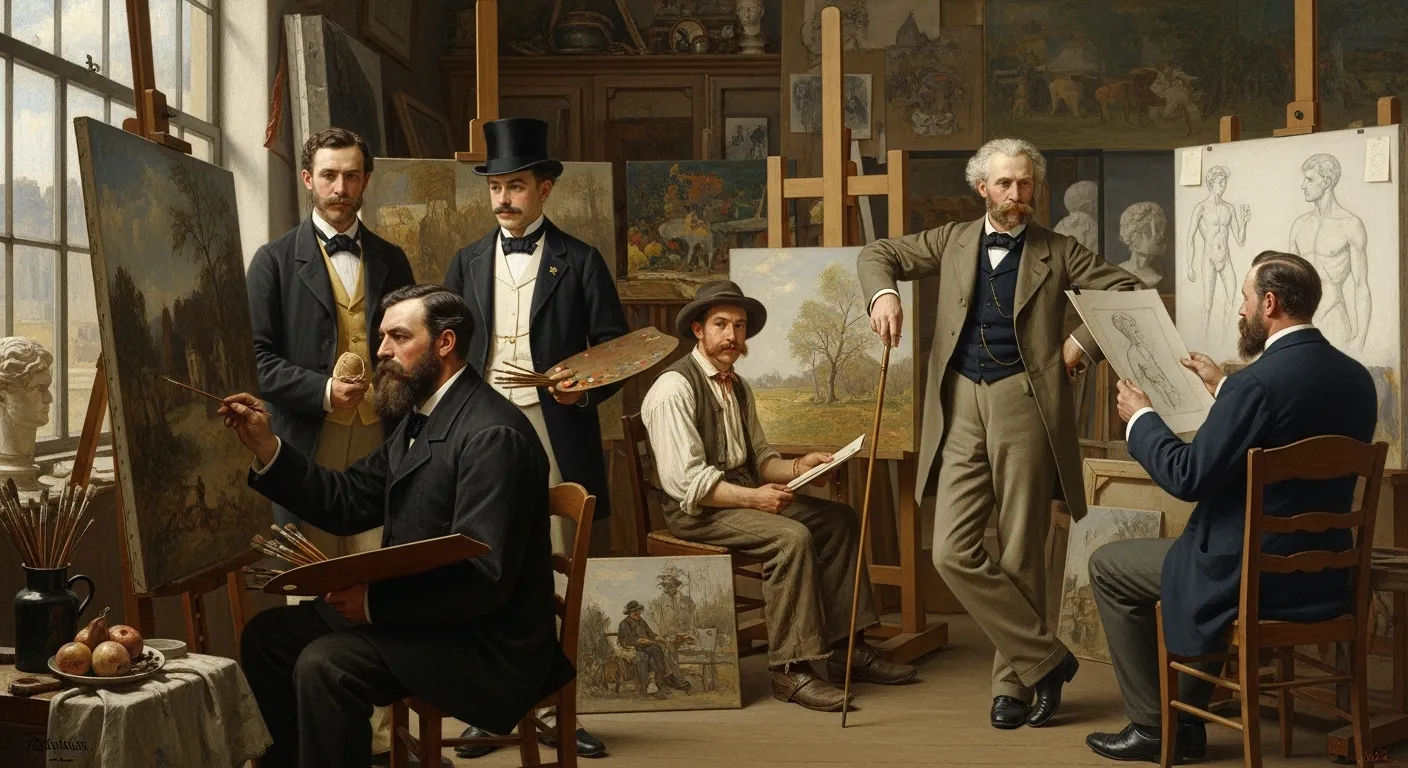
Ever looked at a painting and thought, “Wait—is that a photo or… actual paint?” That’s the magic of famous realist painters. Realism ain’t just about copying what you see—it’s about capturing the soul behind the surface. Born in mid-19th century France as a middle finger to Romanticism’s dramatic flair, Realism said, “Nah, let’s talk about farmers, laborers, and everyday folk—no gods, no heroes, just truth.” And truth, my friends, is messy, raw, and sometimes covered in mud. The famous realist painters didn’t glamorize; they documented. They painted laundresses with tired eyes and butchers with bloodied aprons—not because it was pretty, but because it was real.
Why Gustave Courbet Is the OG of Realism
If Realism had a founding father, it’d be Gustave Courbet—loud, proud, and politically spicy. This dude once built his own pavilion next to the 1855 Paris World’s Fair just ‘cause they rejected his painting The Artist’s Studio. Talk about petty genius! Courbet’s work like The Stone Breakers showed manual labor not as noble allegory but as back-breaking grind. His brush didn’t flinch from dirt, sweat, or social inequality. That’s the heartbeat of famous realist painters: no sugarcoating, just canvas-as-witness. Even his self-portraits? Unapologetically rugged—like he just rolled outta bed after arguing with Marx (who, by the way, totally vibed with his art).
Jean-François Millet and the Poetry of Peasant Life
Millet didn’t just paint peasants—he elevated ‘em. In works like The Gleaners, three women bend low in a golden field, gathering leftover wheat. No halos, no drama—just dignity in exhaustion. Critics back then called it “socialist propaganda,” but Millet? He just said he painted what he knew. Raised on a farm himself, he saw beauty in calloused hands and sunburnt necks. That’s the quiet power of famous realist painters: turning the overlooked into icons. His paintings whisper, “Y’all matter,” while the aristocracy yawns in gilded salons.
Honoré Daumier: The Satirical Soul with a Realist Heart
Daumier might’ve started as a caricaturist roasting French politicians in newspapers, but don’t sleep on his oil paintings. Works like The Third-Class Carriage show ordinary folks crammed on a train—tired moms, old men, wide-eyed kids—all rendered with tenderness, not mockery. His lines were sharp, but his heart? Soft as Sunday pancakes. Daumier proves that famous realist painters ain’t just documentarians—they’re empathizers. He captured the human condition with a wink and a sigh, reminding us that realism can be both critical and kind.
Thomas Eakins: America’s Quiet Realist Maverick
Across the pond, Thomas Eakins was doing his own brand of unflinching realism. While Europe obsessed over peasants, Eakins zoomed in on surgeons, rowers, and professors—folks shaping modern America. His masterpiece The Gross Clinic? A surgical theater bathed in clinical light, blood on the table, students leaning in like it’s a lecture. Critics called it “gruesome,” but Eakins didn’t care. He believed art should reflect truth, even if it made you squirm. That’s the grit of famous realist painters: no filters, no apologies.
Rosa Bonheur: Breaking Barriers with Brushstrokes
Picture this: a woman in 19th-century France wearing pants (illegal at the time!), studying animal anatomy in slaughterhouses, and painting horses so lifelike you swear they’ll gallop off the canvas. Meet Rosa Bonheur—the original boss babe of famous realist painters. Her The Horse Fair stunned Paris with its muscular energy and meticulous detail. She didn’t just paint animals; she understood their spirit. And yeah, she got a special police permit to wear trousers. Because why let fashion dictate your genius?
Ilya Repin: Russian Realism with a Conscience
Realism wasn’t just a Western thing—Russia had Ilya Repin, whose canvases pulsed with moral urgency. Barge Haulers on the Volga shows eleven men dragging a ship against the current, each face etched with exhaustion and resilience. Repin spent months living near the river, sketching real haulers. That’s the commitment of famous realist painters: truth requires immersion. Later, he’d paint revolutionaries, tsars, and intellectuals—not to flatter, but to question. His brush was a mirror held up to society’s contradictions.
Winslow Homer: The Sea, Solitude, and Stark Beauty
Homer didn’t need crowds to capture humanity. Give him a lone fisherman on a stormy coast or kids playing in a sun-dappled field, and he’d spin poetry. His watercolors and oils feel fresh, almost journalistic—but layered with mood. After covering the Civil War as an illustrator, he turned to nature, finding drama in crashing waves and quiet resilience in rural life. That’s the range of famous realist painters: from battlefields to beaches, always chasing authenticity.
Andrew Wyeth: Whispering Realism in Rural America
Fast-forward to the 20th century, and Andrew Wyeth paints loneliness so vivid it aches. Christina’s World—a woman crawling across a field toward a distant farmhouse—became an icon of American realism. Wyeth worked in tempera, layering thin washes to create haunting stillness. He painted neighbors, not celebrities; barns, not ballrooms. His realism wasn’t flashy—it was felt in the creak of floorboards and the slant of afternoon light. That’s the legacy of famous realist painters: making the mundane monumental.
Who Gets Crowned the “Most Realistic” Among Famous Realist Painters?
So who’s the GOAT? Courbet for starting the movement? Eakins for his surgical precision? Wyeth for emotional depth? Honestly, it depends on what “real” means to you. Some say hyperrealists like Chuck Close take it further, but purists argue Realism is about content, not just technique. What’s clear is that famous realist painters share a rebel spirit—they refused to paint fantasies when the world was begging to be seen as-is. For more deep dives, check out the Galerie Im Regierungsviertel, explore our Art category, or read our companion piece on Realistic Paintings by Famous Artists: Iconic Views.
Frequently Asked Questions
Who are the most famous Realist painters?
The most celebrated famous realist painters include Gustave Courbet, Jean-François Millet, Honoré Daumier, Thomas Eakins, Rosa Bonheur, Ilya Repin, Winslow Homer, and Andrew Wyeth. These artists pioneered or advanced the Realist movement by depicting everyday life with honesty and emotional depth, rejecting idealized or romanticized narratives in favor of raw, observable truth.
What artist is known for Realism?
Gustave Courbet is widely regarded as the founding figure of Realism in art. His 1855 manifesto and exhibition—featuring works like The Stone Breakers and The Artist’s Studio—explicitly rejected academic conventions and declared that art should reflect contemporary life. Among famous realist painters, Courbet’s bold stance and unvarnished subjects set the standard for the entire movement.
Who is the best known American realist painter?
Thomas Eakins is often hailed as the greatest American realist painter. His scientifically precise approach—seen in masterpieces like The Gross Clinic and The Agnew Clinic—combined anatomical accuracy with psychological insight. Among famous realist painters from the U.S., Eakins stands out for his uncompromising commitment to truth, even when it unsettled Victorian sensibilities.
Who is the most realistic painting artist?
While “most realistic” can be subjective, among traditional famous realist painters, Andrew Wyeth and Thomas Eakins are frequently cited for their uncanny ability to render texture, light, and emotion with near-photographic fidelity. However, Realism isn’t just about technical precision—it’s about truthful representation of social, emotional, or physical reality, which all major realist painters achieved in their own distinct ways.
References
- https://www.metmuseum.org/art/collection/search?searchField=All&sortBy=Relevance&ft=realism+painting&offset=0&rpp=20
- https://www.tate.org.uk/art/art-movements/realism
- https://www.britannica.com/art/Realism-art
- https://www.nga.gov/collection/movement-realism.html